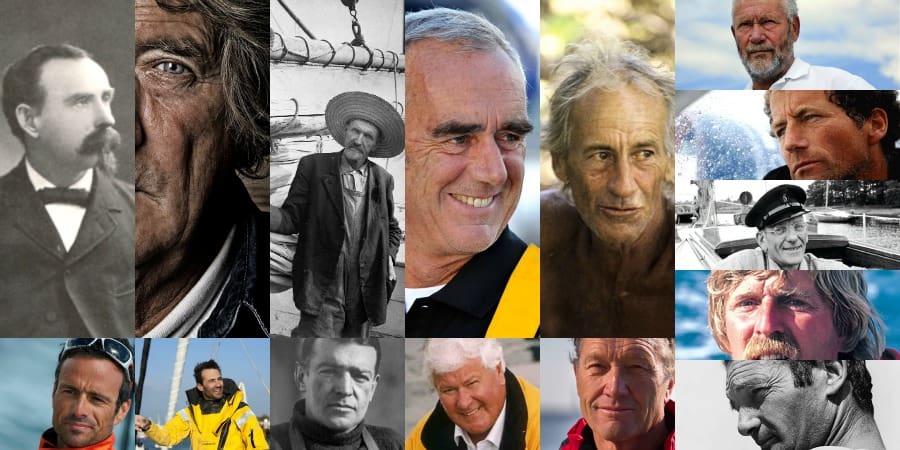
Famous sailors have earned their place in sailing history in different ways. Some completed voyages that had not been attempted successfully before. Others changed ocean racing through boat development, preparation or the way a crew worked together.
Comparing them as if they sailed the same course in the same conditions misses much of the story. A nineteenth-century solo voyage, a crewed multihull record and a modern Vendée Globe campaign involve different resources and demands.
These 15 profiles focus on a specific contribution from each sailor. They form a selection of voyages and careers, rather than a definitive ranking or a complete history of the sport.
Joshua Slocum

Joshua Slocum completed the first solo circumnavigation of the world aboard Spray, sailing between 1895 and 1898. His voyage included stops; it was not a non-stop attempt.
His book, Sailing Alone Around the World, gave later readers a detailed account of navigating and living aboard a small vessel alone. Slocum provides an essential starting point when later solo voyages are described as firsts: the route, number of stops and conditions of any record need to be stated precisely.
Francis Chichester

Chichester returned to Plymouth in May 1967 after sailing Gipsy Moth IV around the world with one stop in Sydney. He had already won the inaugural OSTAR in 1960 aboard Gipsy Moth III.
His circumnavigation brought solo ocean sailing to a much wider public. It was a different achievement from Slocum's earlier voyage and from the non-stop passage Knox-Johnston completed two years later. Read our account of Francis Chichester and Gipsy Moth IV for the distinction.
Robin Knox-Johnston

On 22 April 1969, Robin Knox-Johnston returned to Falmouth aboard Suhaili, completing the first solo non-stop circumnavigation. He was the only finisher in the original Sunday Times Golden Globe event.
His passage showed what a small, prepared boat and a self-reliant sailor could achieve over a continuous voyage. The date belongs to the completion of the achievement: the voyage itself had begun in June 1968.
Bernard Moitessier

Moitessier entered the same Golden Globe event aboard Joshua. After rounding Cape Horn, he continued sailing instead of returning to finish in England, eventually reaching Tahiti.
His decision made the voyage central to a different discussion about long-distance sailing: why a sailor chooses to continue, and whether the purpose of a passage must be defined by a finishing line. He did not win the race. Our Bernard Moitessier profile looks at that choice and his writing.
Chay Blyth

In 1971, Chay Blyth completed a solo non-stop circumnavigation westward aboard British Steel. The direction is important: the passage was made against the prevailing winds and currents encountered on the conventional eastward route through the Southern Ocean.
Blyth's voyage therefore belongs to a distinct record category. Removing the word “westward” from a brief account risks confusing it with Knox-Johnston's earlier non-stop circumnavigation.
Eric Tabarly

Eric Tabarly won the 1964 OSTAR aboard Pen Duick II. The result helped establish a new centre of activity in French offshore racing and linked his name with a succession of boats developed for different kinds of competition.
His significance extends beyond one finish. The Pen Duick projects made boat design and development part of a wider sailing story. It is more accurate to describe that influence than to credit him with being the first sailor ever to use a particular technology.
Peter Blake

Peter Blake skippered Steinlager 2 to victory in the 1989–90 Whitbread Round the World Race, winning all six legs. In 1994 he shared command with Robin Knox-Johnston when ENZA New Zealand set a new crewed circumnavigation benchmark for the Jules Verne Trophy.
Those achievements connect two different forms of ocean sailing: a race with stops and a continuous record attempt. In both, preparation and the ability to sustain a crew's performance were central to the result.
Olivier de Kersauson

Olivier de Kersauson was a central figure in the development of large ocean-racing multihulls. His Jules Verne Trophy successes came in 1997 aboard Sport-Elec and in 2004 aboard Geronimo.
The two campaigns illustrate how successive designs changed the pace of crewed circumnavigation attempts. Sustaining that pace required both a fast boat and a crew capable of keeping it moving through changing conditions.
Franck Cammas

Cammas led Groupama 3 to the Jules Verne Trophy in 2010 and skippered Groupama to victory in the 2011–12 Volvo Ocean Race. The campaigns used different boats and different racing formats.
That range is part of his contribution. A non-stop multihull record attempt and a staged round-the-world race require different approaches to boat handling, crew organisation and the calculation of risk over a long campaign.
Michel Desjoyeaux

Desjoyeaux won the Vendée Globe in 2000–01 aboard PRB and again in 2008–09 aboard Foncia.
The two wins, separated by eight years, show sustained performance in solo non-stop racing as the boats and campaigns developed. The ability to repeat that result across two generations of campaigns gives his career a distinct place in the race's history.
Francis Joyon

In 2008, Joyon established a solo circumnavigation record of 57 days, 13 hours and 34 minutes. The passage was one stage in a career closely associated with long-distance multihull sailing.
His later crewed Jules Verne Trophy campaign aboard IDEC SPORT added another chapter to his round-the-world sailing. The distinction between solo and crewed records is essential when comparing the figures from his career.
Loïck Peyron

Loïck Peyron skippered Banque Populaire V to the Jules Verne Trophy in 2012. He also won the 2014 Route du Rhum aboard Banque Populaire VII.
The two results illustrate the breadth of a multihull career that includes both crewed record sailing and solo racing. They should be read in their historical context, rather than presented as an undated list of records that are still necessarily held.
Alessandro Di Benedetto

Di Benedetto completed a solo non-stop circumnavigation in a modified 6.50-metre boat in 2010. The voyage took 268 days and included sailing with a jury rig after a dismasting before Cape Horn.
The scale of the boat made the undertaking different from a campaign in an ocean-racing multihull or an IMOCA. His later participation in the Vendée Globe connected that independent small-boat voyage with an established round-the-world race.
Ernest Shackleton

Shackleton belongs in this selection as an expedition leader whose story includes a demanding small-boat passage. After Endurance was lost, he and five companions sailed James Caird from Elephant Island to South Georgia in 1916 to seek help.
It was a crewed survival voyage, not a solo sailing record. Navigation, the work of the boat's crew and the rescue effort are all part of the account. Describing it as Shackleton's achievement alone would leave out essential contributions from the others involved.
Bernard Gilboy

Gilboy's 1882–83 voyage in Pacific belongs to the history of small-boat attempts across the Pacific, rather than to the list of completed solo circumnavigations. His account was published as a narrative of the voyage from San Francisco towards Australia.
Including a less familiar sailor also widens the perspective of this selection. Sailing history includes attempts and first-hand accounts as well as completed records and race victories.
How to compare the achievements
Before comparing any two voyages, ask whether they were solo or crewed, non-stop or made with stops, and sailed eastward or westward. Then consider the boat, the route and the rules of the event.
Those details make the careers of famous sailors more interesting. They explain why Slocum, Chichester, Knox-Johnston and Blyth can all occupy a distinct place in the history of sailing around the world.
TABARLY OF COURSE AND BY FAR.OLIVIER DE KERSAUSON IS A JOKE.
You´re missing the Argentinian Vito Dumas, born september 26th, 1900 in Buenos Aires, Argentina.
In june 1942 he circunnavigated the globe from Buenos Aires, around the 40th paralel, in an Argentinian designed and built 8mts boat, arriving in Buenos Aires, september 1943
He explained his trip with these words (my translation) “I´m going in this materialistic age, to a romantic adventure, as an example for the youth”
Absolutely. Vito Dumas sailed across the world within the roaring forties in a small boat in a time where only compass and sextant were available. His stories are thrilling and his courage humongous.
But he didn’t actually do anything to deserve to be on this website?
Eric
Captain Bligh of the Royal Navy, is a logical candidate, as is Magellan.
And yes, I consider them modern, not ancient.
Pete Goss – without a doubt – ask Raphael Dinelli!
Eric Tabarly. No doubt. By far.