
French sailboat brands cover a wide range of sailing. A light performance cruiser, an aluminium centreboarder and a catamaran organised around life aboard may come from the same national industry while answering very different briefs.
The 15 models below provide a way to compare those approaches. They were part of SailUniverse's original 2022 selection and are presented here as examples of each brand's design choices, rather than as a catalogue of new boats all available today.
Some have since been joined or replaced by other models. Equipment and layouts may also vary between build years. “French brand” describes the identity of the business in this guide; it does not mean that every component or every boat is necessarily built in France.
Allures 51.9
Allures focuses on long-distance cruising with an aluminium hull and a composite deck. The 51.9's retractable centreboard is central to its use, allowing draft to be reduced for suitable shallow-water anchorages.
For a buyer, the useful comparison concerns variable draft, the maintenance of its mechanisms and the way the boat carries stores for an extended trip.
Amel 50

The Amel 50 illustrates the yard's use of a sloop rig within a cruising approach associated with protected cockpit arrangements and handling by a small crew.
It should not be described simply as a smaller version of every earlier Amel. Compare the working layout and rig on their own terms, including reefing, access to the engine and the equipment needed to operate the boat with the intended crew.
Beneteau First 36

The Sam Manuard-designed First 36 represents the performance-cruising side of Beneteau's range. It is a different proposition from a cruising yacht whose layout is driven mainly by accommodation.
The useful questions concern sail handling, the use of the cockpit with a small crew and the balance between cruising equipment and weight. Beneteau's French identity should also be distinguished from the build location and specification of the particular boat.
Dufour 32

The Dufour 32 was introduced as a compact cruising model designed with Umberto Felci. Its cockpit and aft arrangements form a substantial part of the boat's proposition for day sailing and time at anchor.
For owners comparing boats in this size range, try those features alongside the less visible tasks: stowing equipment, reaching the machinery and preparing the boat with one or two people. A flexible leisure space needs to work with the crew's sailing routines.
Jeanneau Sun Odyssey 380

The Sun Odyssey 380 combines naval architecture by Marc Lombard's design team with an interior developed with Piaton. The deck circulation is one of the distinguishing elements to examine when comparing it with other family cruisers.
Walk the route from the cockpit to the foredeck and test the movement below. The arrangement of cabins, storage and working space matters more than a nominal berth count when the boat is used for several weeks at a time.
Pogo 44

Pogo Structures takes a more performance-led approach to cruising. The Finot-Conq-designed Pogo 44 uses a broad hull and a lifting-keel arrangement within a boat developed for active sailing.
It is useful to compare with heavier cruisers if passage speed and sailing response are priorities. The keel mechanism, sail inventory and loaded displacement need to be understood together; draft flexibility is one element of the whole boat, rather than a substitute for preparation.
RM970

RM's plywood-epoxy construction provides a different material approach from the production GRP boats in this guide. The RM970 also places an emphasis on visibility and natural light below deck.
When comparing an original 970 with a later update, establish the exact version and keel configuration. For an older boat, inspect the structure and coatings with reference to the construction method, rather than applying assumptions drawn from a different kind of hull.
Bali 4.4
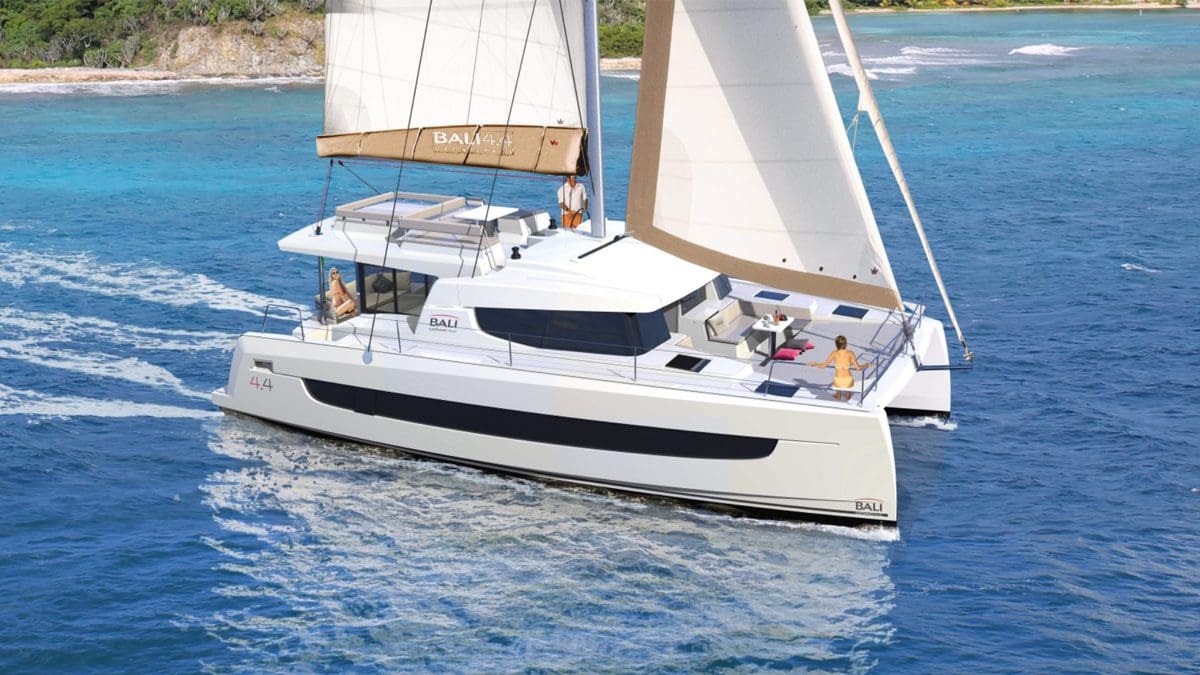
Bali's 4.4 reflects the brand's focus on the relationship between indoor and outdoor living spaces. The opening aft door and forward deck arrangements change how the crew uses the boat at anchor.
During a viewing, assess how those spaces are secured and managed underway as well as how they feel in port. Storage, ventilation and the weight of equipment carried aboard remain important alongside the appeal of a large social area.
Excess 15

The Excess 15 is an example of the brand's cruising-catamaran approach, with a VPLP design. It was also the platform for the E'Lab prototype fitted with Torqeedo Deep Blue Hybrid propulsion, presented in 2021.
That prototype must be distinguished from the standard model. Its electric and hybrid equipment, and the results of its trials, should not be presented as features of every Excess 15. Identify the actual propulsion installation and its documentation when assessing a boat.
Fountaine Pajot Isla 40

The Isla 40 provides an example of a smaller cruising catamaran within Fountaine Pajot's range history. Its accommodation can be compared with the working and storage space available for family sailing.
Choose the layout according to how the boat will be used. Additional cabins may be useful for guests, while an owner planning longer trips may place more value on storage and access. Specifications and equipment should be checked for the build year being considered.
Garcia Explocat 52
The Explocat 52 extends Garcia's aluminium-building approach into a cruising catamaran. It offers a material and design comparison with composite multihulls aimed at a similar long-distance programme.
Aluminium construction should be understood through the actual installation and maintenance requirements. Inspect the layout, coatings, systems and access for repair as a package. The choice of hull material alone does not determine which routes or conditions a particular boat and crew are ready for.
Lagoon 55

The contemporary Lagoon 55 combines naval architecture by VPLP with an interior by Nauta Design. Its use of deck and living space places it at a different scale from the smaller catamarans in this selection.
The model should not be confused with the original Lagoon 55 from the yard's early history. When comparing photographs and specifications, identify the generation and edition, then assess the crew and maintenance requirements of the actual yacht.
Nautitech 40 Open

The Nautitech 40 Open provides another way to organise the relationship between the cockpit, helming positions and saloon. The Open concept is relevant to owners who want the working deck and social space to remain closely connected.
On a used example, inspect sightlines from the helm, weather protection and the route used to handle lines. These practical details should be tested by the crew who will sail the boat, rather than judged solely from a plan.
Outremer 55

The Outremer 55 represents the brand's performance-oriented approach to ocean cruising. It provides a useful comparison with catamarans that devote more of their design brief to accommodation volume.
For long passages, assess the boat's loading plan and sail-handling arrangements. Extra equipment, stores and tenders need to be considered against the intended sailing performance. The number of people a boat can accommodate in port is not the same as the load plan for a crossing.
Windelo 50 Adventure

The Windelo 50 Adventure introduced a combination of basalt-fibre composite construction, electric propulsion and an energy system incorporating generation and storage. It also uses a forward working area, giving it a distinct layout within this group.
The original Adventure model and later Windelo 50 developments should be identified separately. Electric motors do not mean that all propulsion or energy use is emissions-free: the installed generator, batteries, charging sources and actual operating pattern all belong in the assessment.
Compare the programme before the brand
A useful shortlist begins with sailing plans. Decide whether the boat will be used mainly for weekends, family cruising, extended liveaboard travel or fast passages. Then establish limits for draft, dimensions, maintenance and the number of people needed to operate it.
The differences between these French sailing brands become clearer when those requirements are explicit. Pogo and RM offer alternatives to a conventional accommodation-led cruiser; Allures and Garcia make construction material part of the decision; the catamaran builders offer several distinct approaches to the working and living spaces.
For a wider international comparison, see 18 bluewater sailboats and their design choices. If you are beginning with a used purchase and a smaller size limit, our guide to used cruising sailboats under 40 feet explains how to assess the individual boat and its preparation costs.