
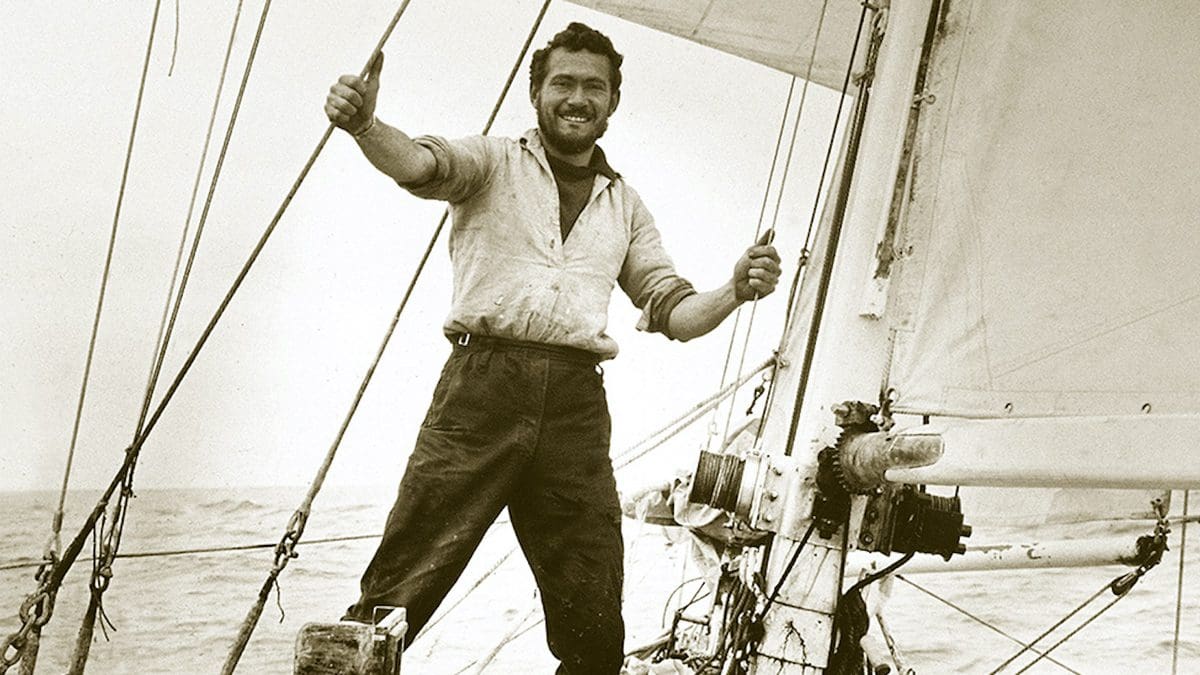


Robin Knox-Johnston became the first person to sail around the world alone and without stopping when he returned to Falmouth aboard Suhaili on 22 April 1969. He had left the Cornish port on 14 June 1968. The voyage lasted 312 days, and he was the only competitor to finish the Sunday Times Golden Globe Race.
The distinction matters. Joshua Slocum had already completed a solo circumnavigation, and Francis Chichester had sailed around the world singlehanded with a stop in Sydney. Knox-Johnston’s achievement was to keep going without a port stop, maintaining both himself and his yacht through an entire circuit.
The seaman before the record
Born in Putney, London, on 17 March 1939, Knox-Johnston went to sea in the Merchant Navy in 1957 and gained his Master’s Certificate in 1965. His background was professional seafaring, years before the return to Falmouth made him widely known.
That experience helps explain the practical character of the voyage. The problem was not simply to sail a long distance alone. It was to keep a small vessel working through months of wear, carry provisions for an uncertain passage and make decisions with limited information. A non-stop attempt removed the opportunity to hand a developing fault to a boatyard along the way.
Suhaili: a boat he already knew
Suhaili was a 32-foot, teak-built ketch constructed in Bombay, now Mumbai. Her double-ended hull belonged to the Colin Archer tradition, through William Atkin’s Eric design. Her hull form reflects a tradition developed for boats expected to work in demanding sea conditions.
She was launched in December 1964. Before the Golden Globe, Knox-Johnston had already gained substantial experience of her on the passage from India towards Britain. That familiarity mattered when sponsorship for a larger purpose-designed yacht did not materialise and Suhaili became the boat for the attempt.
Her rig carried a mainmast and a smaller mizzenmast. For a solo skipper, how a boat balances under sail is a working concern, particularly when mechanical steering cannot be relied on. Suhaili’s importance was not that she represented the fastest available design. She was a substantial wooden boat whose skipper understood how she behaved.
A race without a single starting day
The 1968 Golden Globe did not begin with a fleet crossing one line together. Competitors could depart from the British Isles within a permitted window and were required to return to their departure port. The newspaper offered a trophy for the first return and a separate £5,000 prize for the fastest passage.
Nine men started. Knox-Johnston was the third to leave, on 14 June. Bernard Moitessier departed Plymouth aboard Joshua on 22 August. Those different departure dates are essential when reading comparisons between their progress: being ahead on the ocean and making the fastest elapsed passage were different things.
For the wider context of the challenge, Francis Chichester’s voyage in Gipsy Moth IV explains the achievement that preceded the non-stop attempt.
Keeping the boat going when equipment failed
Knox-Johnston’s own account describes a succession of problems before and during the Southern Ocean passage. Suhaili suffered storm damage, contaminated water supplies and the loss of her radio. The communications failure also deprived him of radio time checks used in celestial navigation, as well as weather forecasts.
The self-steering eventually failed off Australia. From then on, the alternatives were to balance the boat under sail or steer by hand. That changed the demands of daily life aboard: a lone skipper still needed time to navigate, repair equipment and rest while the boat continued sailing.
This is the technical centre of the story. A completed non-stop circumnavigation required more than a sound hull at departure. Sails, steering and fittings had to remain usable, or be repaired and worked around, after months at sea. The skipper’s relationship with the particular boat became as consequential as the original preparation.
Cape Horn and the return to Falmouth
Knox-Johnston rounded Cape Horn on 17 January 1969 and continued north through the Atlantic. On 22 April he returned to Falmouth, completing the circuit and securing the Golden Globe. Guinness World Records records that date for the first solo non-stop circumnavigation under sail.
Moitessier chose a different ending. After rounding Cape Horn, he continued east rather than returning to finish in Britain, eventually reaching Tahiti. His decision belongs to his own story, explored in our profile of Bernard Moitessier.
Donald Crowhurst’s voyage ended in tragedy after false position reports. Knox-Johnston later gave his prize money to Crowhurst’s family. The race therefore needs to be understood through its different human outcomes, as well as its winning passage. Sail Universe’s archive article about Crowhurst and The Mercy provides related context.
A career beyond Suhaili
Knox-Johnston continued racing long after 1969. He and Peter Blake won the Jules Verne Trophy aboard Enza New Zealand in 1994. He was knighted in 1995, and later completed the 2006–07 Velux 5 Oceans race in fourth place, finishing at the age of 68.
He also founded the Clipper Round the World Yacht Race, whose first edition departed Plymouth in October 1996. Its crewed format and training programme took ocean racing in a different direction from his solitary voyage, giving people from varied backgrounds a structured route into offshore competition.
Why the voyage still matters
Suhaili’s circumnavigation established that one person could keep a yacht and himself going around the world without a port stop. The story remains useful to sailors because its difficulties are concrete: steering, navigation, maintenance and the limits of a particular boat. The scale of the achievement comes from how long those responsibilities continued without relief.
The boat also connects the record with later sailing history. Our 2018 archive report on Joshua and Suhaili in Les Sables d’Olonne recalls the two yachts ahead of that year’s Golden Globe Race. Together, their stories show why the 1968–69 event remains a reference point for understanding solo ocean sailing. Our guide to 15 famous sailors and their achievements places the voyage alongside other milestones in sailing history.
The archive also includes My Classic Boat’s film of Knox-Johnston racing Suhaili in 2016 and a 2017 note on his Avaunt interview about adventure, offering later perspectives on the sailor and his boat.
Sources: Knox-Johnston’s account of the Golden Globe, Golden Globe Race history, Trophée Jules Verne biography and Clipper Race heritage.

