
When a yacht is in trouble offshore, another sailing boat may be the closest available help. But bringing the crew of a damaged or sinking yacht aboard a small rescue vessel can be one of the most difficult parts of the emergency. The problem is not simply finding the people in distress. It is keeping two crews safe while boats, liferafts and people move in an unpredictable sea.
An October 2026 study led by the Cruising Club of America (CCA), in cooperation with US Sailing and the Bermuda Race Foundation, examines 28 documented yacht-to-yacht crew rescues. Its findings are useful to cruising sailors and racers because they focus on decisions, communication and the practical work of transferring people—not on rescue equipment alone.
What the 28 rescue cases show
The CCA’s report announcement describes a 63-page examination developed after incident reviews related to the 2024 Newport Bermuda Race. The team studied documented incidents and, in some cases, interviewed sailors involved. The reviewed cases include offshore racing and cruising situations in which another yacht was able to provide direct assistance.
The report classifies 23 incidents as sinkings and five as disabled yachts. It records no fatalities in these 28 incidents, but these documented successful rescues are not a representative sample of every yacht emergency. The study cannot tell us the overall probability that a rescue will succeed, and it does not identify one manoeuvre suitable for every boat.
The report highlights five recurring stages: locating and communicating with the vessel in distress; preparing the boats and crews; agreeing on abandonment and approach; transferring people; and meeting the needs of those rescued afterward. The practical value lies in thinking through those stages before an emergency occurs.
1. Establish communication and locate the people in distress
A yacht hearing a distress call should establish whether rescue coordination authorities have been alerted and relay the emergency when needed. Record the position and its time, the vessel’s identity, number of people, condition of the yacht, available communications, injuries and whether a life raft has been launched. A yacht assisting another should coordinate with rescue authorities wherever possible rather than attempting to manage the whole incident in isolation.
VHF voice contact can be invaluable when the yachts are near one another. DSC, EPIRBs, PLBs, AIS-based personal locating devices, satellite communications and visual signals may each contribute, depending on what is fitted and operating. But equipment will not resolve confusion if nobody knows which position is current or who is speaking.
The report notes that unregistered emergency beacons complicated some responses. Offshore crews should register beacons correctly, keep registration information current and know how to communicate a precise position. A handheld VHF, suitable personal locator and signalling equipment should be available with the abandon-ship kit where appropriate.
2. Prepare the rescue yacht before closing the distance
The report recommends preparing the yacht and crew while proceeding to assist, as circumstances allow. Assessment and preparation should not become a reason to delay an urgent response. Reduce or secure sail as appropriate, secure the boom, assign helm and lookout duties, and prepare a recovery area, lines and first-aid equipment. Crew working on deck need properly fitted lifejackets and suitable restraint arrangements. The rescue yacht must remain manoeuvrable throughout the operation.
Assign distinct jobs: one person directing the operation, one maintaining communications, one handling the helm, and others preparing the recovery and first aid. On a small shorthanded yacht these roles may overlap, which makes it more important to agree what will happen before the final approach.
Consider the sea state, the position of the damaged yacht, its rig and any debris in the water. A sinking or dismasted boat can have loose rigging and ropes that threaten a propeller. High freeboard, lifelines, an exposed transom or poor access from water level may make boarding difficult. Assess those constraints before committing to a transfer method.
3. Agree on an abandonment and approach plan
The CCA identifies a shared plan between the two skippers as one of the important factors in successful rescues. Brief both crews on when and how people will leave the yacht, where the rescue vessel intends to approach, what equipment they should bring and how communication will be maintained. The distressed yacht’s skipper remains responsible for their crew; once abandonment is agreed, the rescuing skipper will usually coordinate the approach and transfer.
The rescuing skipper will usually direct the transfer manoeuvre because they are responsible for the handling and safety of the rescue vessel. That does not remove the other skipper’s responsibility for their own crew. The plan must remain flexible: a change in wind or a failed approach is a reason to reassess, not to force a manoeuvre.
The decision to abandon a vessel is time-critical but cannot be reduced to a universal rule. A severely damaged yacht may remain a safer platform than a life raft for a period, while rapid sinking can eliminate that option. A skipper must weigh the immediate condition of the vessel, the location of rescue assets and the danger of waiting too long.
4. Transfer the crew: why the life raft often matters
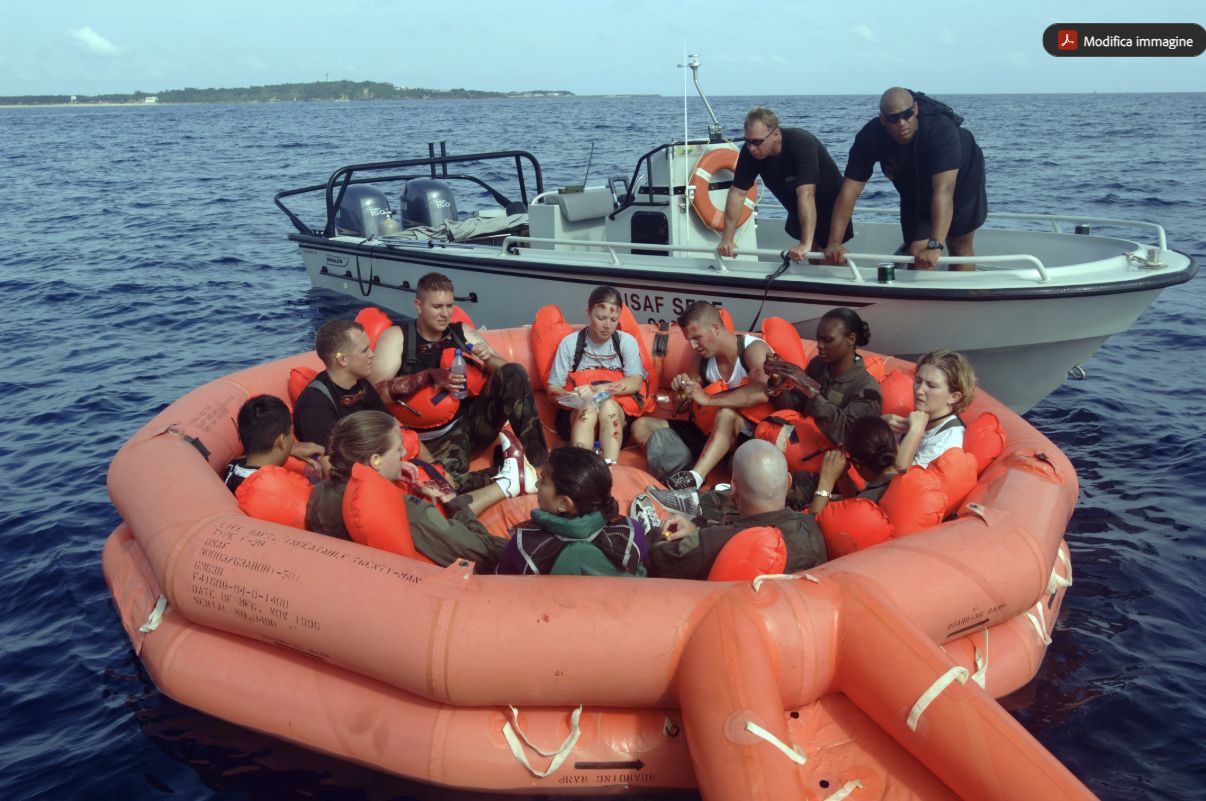
Many of the reviewed rescues used a life raft as the means of transfer. A raft can provide a separation between a damaged yacht and the rescue boat and reduce the need to bring two moving hulls directly alongside. It is not risk-free. Wind and waves can push the raft away; painter lines and other gear can foul a propeller; and people can fall into the water during transfer.
The CCA recommends assessing drift, waves and trailing lines before the final approach, including the raft’s drogue and painter. The choice between boarding at the stern or amidships depends on the boats, their orientation and the sea state; neither is universally safer. Avoid direct yacht-to-yacht transfer when another suitable option exists. A raft must be controlled and secured for the transfer, with arrangements that account for substantial line loads and the danger of crushing or propeller fouling. The report favours a single transfer when capacity and conditions allow, while recognising that some incidents require more than one trip.
Recovery equipment is useful only if it matches the height of the rail, the condition of those being rescued and the strength of the crew doing the lifting. A boarding ladder may be unsuitable for a person who is injured, exhausted or unable to climb. A recovery sling or lifting system may be needed, but it must be suitable for recovering a person and used within the equipment manufacturer’s instructions and the crew’s training. The CCA review panel advises against deliberately putting people into the water to swim between the yachts.
Keep track of every person during the manoeuvre, including the last person leaving the casualty. Confirm that each has actually boarded the rescue yacht before concluding the transfer.
Two rescues that illustrate the challenge
Kirsten Neuschäfer and Tapio Lehtinen
During the 2022 Golden Globe Race, Kirsten Neuschäfer rescued Tapio Lehtinen after his yacht sank in the southern Indian Ocean. Neuschäfer wrote the foreword to the CCA report, drawing attention to details that can be overlooked in pre-departure checks. Her foreword describes the difficulty of locating a raft against the rising sun and the value of daylight smoke signals. Even the lack of spare reading glasses affected the practical use of emergency communications and instructions.
Those details matter because a rescue is a chain of small tasks under pressure. A fully equipped grab bag is not sufficient if the crew cannot identify or operate its contents.
Jean Le Cam and Kevin Escoffier
During the 2020 Vendée Globe, Jean Le Cam recovered Kevin Escoffier after Escoffier’s IMOCA suffered a major structural failure. The incident is a reminder that an experienced ocean racer may still need help from another yacht rather than a shore-based asset. The central difficulty was not only reaching the reported area but locating Escoffier’s life raft and bringing him aboard in open-ocean conditions.
These cases are not templates to copy. They show why communications, visual identification, boat handling and a workable recovery arrangement need to function together.
5. The rescue is not finished when everyone is aboard
A successful transfer changes the situation aboard the rescuing yacht. There may be more people than the normal berths, food and water supply, watch schedule or lifesaving equipment were designed to support. Medical problems can be delayed or difficult to assess; shock, fatigue, exposure and emotional distress can affect apparently uninjured sailors.
The report calls for a prompt assessment of the rescued crew’s physical and emotional condition, including possible injuries and cold exposure. Provide first aid within the crew’s training and seek medical assistance through the rescue coordination service where needed. Report who has been recovered and what help remains necessary, then agree whether to divert or rendezvous with another rescue asset.
Keep a record of the people recovered and maintain a clear chain of responsibility. Report the status and location of any abandoned yacht, raft and activated beacons to the rescue coordination authority. Account for portable beacons after the transfer and coordinate their status with that authority. A beacon deliberately left with a floating vessel requires an explicit plan and notification, so it does not prompt another unnecessary rescue attempt.
Crews planning an ocean passage can put these preparations in context with our guide to sailing from the Canary Islands to the Caribbean, including realistic passage times, crew routines and contingency planning.
What offshore skippers can practise before departure
A rescue drill need not reproduce a dangerous offshore transfer to be useful. It can establish roles and reveal practical limitations while the yacht is still in controlled conditions.
- Communications: rehearse a distress relay, position reporting and contact between the helm and the person managing communications. Use simulated messages during drills; do not transmit a false distress call or activate emergency alerts.
- Boat preparation: rehearse reducing sail, assigning a lookout and preparing a safe working area without losing control of the yacht.
- Recovery arrangements: test the boat’s method for lifting an incapacitated person from water level, using appropriate training conditions and qualified supervision.
- Grab bag: check handheld communications, beacon registration, signalling devices, batteries, medicines, waterproof clothing and personal essentials such as glasses. Confirm which items will actually go into the raft and remain accessible.
- Aftercare: review medical supplies, emergency food and water, crew capacity and the process for transferring responsibility to rescue authorities.
General safety-at-sea training remains important even if a full yacht-to-yacht rescue cannot be rehearsed. The CCA’s earlier guidance on rendering assistance also discusses recovery equipment, manoeuvring near another vessel and the obligation to help without unnecessarily endangering your own crew.
What the 28 cases cannot tell us
The report is a collection of documented rescue experiences, not a controlled comparison of transfer methods. Successful outcomes among the selected cases should not be interpreted as evidence that yacht-to-yacht rescues are generally low-risk. Serious failures and situations in which no rescue was possible may be missing from the available record.
Nor does the evidence make a life raft the right solution in every incident. A heavily damaged yacht, a high-freeboard rescuer, severe breaking seas, an incapacitated person or an engine at risk of fouling can change the safest available option. Decisions remain dependent on the actual conditions and the direction of rescue coordination authorities.
Offshore rescue is part of seamanship
For an ocean crew, safety preparation often focuses on surviving the loss of its own boat. The CCA report asks sailors to consider the other side: what they can realistically do when a nearby yacht calls for help. Preparation starts with honest limits, functioning communication equipment and roles the crew understands. The lesson of these 28 cases is not that rescue is simple, but that a shared plan and controlled decisions can prevent an already serious emergency from becoming worse.
For more on emergency equipment and personal preparation, see Sail Universe’s earlier sailing survival equipment article. The new report provides a reason to revisit the issue from the perspective of a potential rescuer.
Sources
Primary document: CCA Report of the Yacht-to-Yacht Crew Rescue Review Team, October 2026 (63 pages; outcomes on page 11, incident classification on page 12, decision-making on pages 14–20, communications and preparation on pages 21–30, transfer on pages 37–45, and aftercare on pages 46–48).
Cruising Club of America — Yacht to Yacht Rescue Report (October 2026); CCA report overview and official lessons; Practical Boat Owner — report coverage and case examples; CCA — Rendering Assistance.
This article discusses seamanship lessons from documented incidents. It does not replace formal sea-survival training, equipment instructions, current SAR directions or the skipper’s assessment of conditions.
Featured photograph: rescue training at White Beach, Okinawa, 8 August 2005, not one of the report incidents. Master Sgt. Val Gempis / U.S. Air Force; public domain in the United States. Resized for web.
