
A sailing passage from the Canary Islands to the Caribbean commonly takes around three weeks, but the range is wider than that simple answer suggests. World Cruising Club gives approximately 18–21 days for the average yacht on the ARC’s 2,700-nautical-mile route from Gran Canaria to Saint Lucia. A boat averaging four knots over that distance would need just over 28 days, before allowing for additional miles.
The difference matters when planning an Atlantic crossing. A passage estimate helps establish a likely arrival window; it should not become a deadline that determines decisions at sea.
For crews sailing west, the main questions are connected: when to leave, how far south to sail before turning west, whether to stop in Cape Verde, and what daily progress the boat can sustain with its ocean-going load and watch system.
How far is the Atlantic crossing from the Canary Islands?
There is no single distance between the Canaries and “the Caribbean”. The departure island, destination and route all affect the total. Two established rally routes provide useful reference points:
| Passage | Approximate published distance |
|---|---|
| Las Palmas, Gran Canaria, to Rodney Bay, Saint Lucia | 2,700 nautical miles |
| Las Palmas to Mindelo, São Vicente, Cape Verde | 850 nautical miles |
| Mindelo to Grenada | 2,150 nautical miles |
These are World Cruising Club’s published route distances for the ARC and ARC+. They are planning references, rather than predictions of the distance an individual yacht will log. The Cape Verde itinerary also finishes farther south, in Grenada, so it is not a direct comparison between two routes to the same destination.
The distinction between charted distance and distance sailed is important. Weather routing, sailing angles, gybes and the final approach can all add miles. A route drawn across a chart does not account for the boat’s ability to make progress in the wind and sea conditions encountered.
Nor do these figures include reaching the Canaries. A yacht departing from northern Europe or the Mediterranean needs a separate plan for that passage, including stops, weather delays and preparation time before the ocean crossing.
How long does it take to sail from the Canaries to the Caribbean?
For a first calculation, divide the proposed distance by the boat’s realistic daily run. The following table uses a fixed passage distance of 2,700 nautical miles. It is arithmetic, not a set of observed crossing averages, and assumes the stated speed is sustained over the full distance.
| Average speed over ground | Distance in 24 hours | Calculated passage time |
|---|---|---|
| 4 knots | 96 nautical miles | 28.1 days |
| 4.5 knots | 108 nautical miles | 25.0 days |
| 5 knots | 120 nautical miles | 22.5 days |
| 5.5 knots | 132 nautical miles | 20.5 days |
| 6 knots | 144 nautical miles | 18.8 days |
| 7 knots | 168 nautical miles | 16.1 days |
A useful estimate starts with the boat’s sustained performance, including slower nights and light-air periods. An afternoon spent making seven knots does not establish a seven-knot passage average.
It is also necessary to keep distance and speed consistent. Speed over ground describes movement along the track; progress towards the destination may be lower when sailing an indirect course. If the route grows longer, the calculation must grow with it.
For example, a hypothetical 2,900-mile passage at an average of five knots takes approximately 24.2 days, compared with 22.5 days over 2,700 miles. That difference comes entirely from distance, without introducing a breakdown or an unusually slow spell.
Use the boat’s loaded performance
An offshore cruising yacht carries water, food, fuel, spare parts and equipment that may be absent during coastal sailing. The relevant performance is what the boat can maintain in that condition.
Crew arrangements matter too. A sail combination that performs well with everyone awake may be unsuitable for a small night watch. A conservative overnight sail plan can reduce speed while making the boat easier to manage.
When assessing likely daily runs, ask:
- What has the boat achieved on previous passages with comparable loading?
- How well does it sail in light following winds?
- Which sails can the watch crew handle without calling everyone on deck?
- Can the self-steering system manage the expected conditions?
- How much does performance change when the crew reduces sail for the night?
A passage estimate should reflect those answers.
When is the best time for a westbound Atlantic crossing?
November and December are established departure months for the Canaries-to-Caribbean crossing. The ARC 2026 is scheduled to leave Las Palmas on 22 November, while ARC+ 2026 starts on 8 November. Their schedules should not be treated as weather advice for an independent yacht.
Tropical cyclone season is a central consideration. The US National Hurricane Center defines the Atlantic hurricane season as 1 June to 30 November and notes that tropical cyclones sometimes occur outside those dates. A November departure therefore still falls within the official season; the change to December does not create a guarantee of benign conditions.
The practical decision involves more than choosing a month. Crews need to assess the current tropical outlook, the broader North Atlantic weather pattern, conditions around the Canaries and the boat’s readiness.
A booking in the Caribbean, a flight home or a rally start may provide a target date. None resolves an unsuitable forecast or an unfinished repair.
Why do yachts sail south before heading west?
The westbound route is associated with the northeast trade winds, but reaching useful trade-wind conditions is not always a matter of leaving the harbour and steering towards the destination.
The underlying circulation helps explain the route. Air descends in the subtropical high-pressure belt, and part of the surface flow returns towards the equator as the trade winds. In the North Atlantic, the Azores High is a major feature of that pattern, as the Met Office’s explanation of large-scale winds describes.
For a yacht leaving the Canaries, the position and extent of the high-pressure system influence the available wind. A more southerly course may offer better sailing conditions than an early turn west. It can also add distance.
This creates a routing decision: whether additional miles are likely to produce enough improvement in wind, boat speed or conditions to justify sailing them.
There is no fixed latitude at which every yacht should turn west. The appropriate route depends on the weather pattern, its expected development, the yacht’s performance and the crew’s priorities.
A southern route does not guarantee stronger winds
A contemporary account of the 2016 ARC illustrates the limits of a standard formula. Boats taking the traditional southern route initially experienced light winds before the trades strengthened, while a developing low-pressure system created a very different opportunity for some fast racing yachts farther north.
That was a particular crossing, not a recommendation to follow a northern alternative. Its relevance is that the same ocean can present substantially different choices from one departure to another. The familiar advice to head south before turning west describes a broad strategy. A current forecast is needed to turn it into a passage plan.
Should you cross directly or stop in Cape Verde?
A Cape Verde stop divides the voyage into two passages. It also introduces another arrival, departure and period ashore.
World Cruising Club publishes indicative ARC+ durations of five to seven days from Las Palmas to Mindelo and 12–16 days from Mindelo to Grenada, with four to six days ashore between the legs. These are organiser estimates for that itinerary, rather than limits applicable to every yacht.
Sailing without a Cape Verde stop
A nonstop passage from the Canaries avoids an intermediate port call and its associated time ashore. Crews can still take a southerly route without entering Cape Verde. The boat must leave prepared for the full passage, with its provisions, water arrangements, maintenance and essential systems already addressed.
Stopping in Mindelo
A stop can provide an opportunity to rest, reassess the boat and deal with issues discovered on the first leg. It also allows crews to experience Cape Verde as part of the voyage.
However, a stop should not be the assumed solution for unfinished preparation. If the plan depends on a particular repair, spare part or service in Mindelo, availability and timing need confirming before departure.
The relevant comparison is total elapsed time. Two shorter passages may feel more manageable, but the days spent ashore must be included when arranging leave, crew changes or onward travel.
What changes the crossing time?
Light winds
A few slow days can materially change the average. Light-air performance deserves attention during preparation, particularly on a boat whose usual sailing experience has involved coastal breezes and shorter trips.
Motoring may recover some progress, but its contribution must be calculated from usable fuel, measured consumption and the reserve retained for other needs. Engine hours used for charging also belong in the energy and fuel plan.
Sailing angles
The quickest route through the water is not necessarily the quickest route to the destination. A yacht may make better speed sailing at an angle to the downwind course, but the additional distance has to be counted. Another boat may maintain useful progress on a deeper angle with a different sail arrangement. This is one reason a crossing estimate based only on boat length is inadequate.
Sea state and steering
Wind strength alone does not describe the conditions. Swell direction, wave pattern and the boat’s motion affect steering, sail handling and the crew’s ability to rest.
World Cruising Club’s report on the 2021 ARC, published by the Government of Saint Lucia, described strong trade winds combined with confused seas and swell from a separate weather system. A downwind crossing can still place substantial demands on both crew and equipment.
Sail Universe’s interview with the skipper of a Windelo 54 Sport provides a boat-specific account of how performance, conditions and life aboard interacted over two Atlantic passages. Such accounts offer context, although their daily runs should not be transferred directly to another yacht.
Squalls and sail changes
Trade-wind sailing does not mean an unchanging breeze. Squalls can interrupt otherwise steady conditions. The effect on passage time depends partly on how the crew manages the boat between and during those changes. A sail plan that requires frequent, difficult interventions may be less sustainable than one that gives away some peak speed.
Equipment problems and fatigue
A steering fault, damaged sail or charging problem can change the passage plan even when the weather remains favourable. Fatigue can have a similar cumulative effect. If the watch system does not allow sufficient rest, sail handling and routine maintenance become harder. The speed assumed before departure may no longer be practical.
A realistic estimate includes the way the crew intends to sail the boat for several weeks.
How much extra time should you allow?
Separate three decisions: the expected passage duration, the supplies and reserves required, and the earliest date on which an onward commitment is sensible. They serve different purposes.
The expected duration can be revised as the crossing develops. Supplies and reserves must account for a slower passage and relevant failures before departure. Travel arrangements need enough flexibility to avoid turning an estimated arrival into pressure to keep sailing.
There is no single extra allowance suitable for every boat. A crew should examine slower scenarios explicitly: reduced daily runs, extra route distance, loss of a useful sail, or time spent resolving a technical problem.
Water planning should also address the consequences of losing the watermaker, where fitted. Electrical planning needs to consider the equipment required to steer, navigate and communicate, together with the generation available to support it. The objective is to understand how the passage remains manageable when it takes longer than expected.
For crews preparing a recently purchased boat, our used sailboat refit budget guide explains how to separate essential repairs, preparation for the intended passage and optional improvements.
Choosing a Caribbean landfall
Saint Lucia and Grenada are established rally destinations, but the intended island should be chosen as part of the passage plan rather than added after calculating a generic Atlantic distance.
The final approach deserves preparation before departure. Confirm entry procedures, suitable arrival options, chart coverage and alternatives if the expected harbour cannot be used.
As the boat approaches land, update the arrival estimate and assess the implications of darkness, weather and crew fatigue. Completing the ocean miles does not remove the need for a considered landfall.
Frequently asked questions
Can you sail from the Canaries to the Caribbean in two weeks?
A 2,700-mile passage completed in 14 days requires an average of approximately eight knots over the full distance. Some yachts can sustain that performance in suitable conditions, but it should only form a planning assumption when supported by the boat’s capability and passage evidence.
Is three weeks a realistic Atlantic crossing time?
It can be. Over 2,700 nautical miles, a 21-day passage requires an average of about 5.4 knots. Whether that is realistic depends on the distance actually sailed, conditions and the yacht’s sustained performance.
Do you have to stop in Cape Verde?
No. Boats can sail from the Canaries to the Caribbean without an intermediate stop, including on routes that first take them south. A Cape Verde call is a separate itinerary choice.
Do you cross the doldrums on this route?
The standard Canaries-to-eastern-Caribbean passage does not require crossing the equatorial Intertropical Convergence Zone. The ITCZ is the region where the northern and southern trade winds converge, associated with thunderstorms, heavy rain and areas of light wind. Its position changes seasonally. Light winds encountered on a northern tropical route should not automatically be described as “the doldrums”.
Does the same route work for sailing back to Europe?
The return passage needs a separate plan. It is not simply the westbound route sailed in reverse. Sail Universe’s account of a Windelo 50’s North Atlantic circuit illustrates how different the outward and return itineraries can be.
For the westbound crossing, begin with a credible daily run, calculate the likely distance and examine slower scenarios. Revisit the route as forecasts develop, and keep the arrival date flexible enough for the boat and crew to make their own pace.
This guide provides passage-planning context. Use current charts, forecasts, warnings and local entry information when preparing an actual voyage.
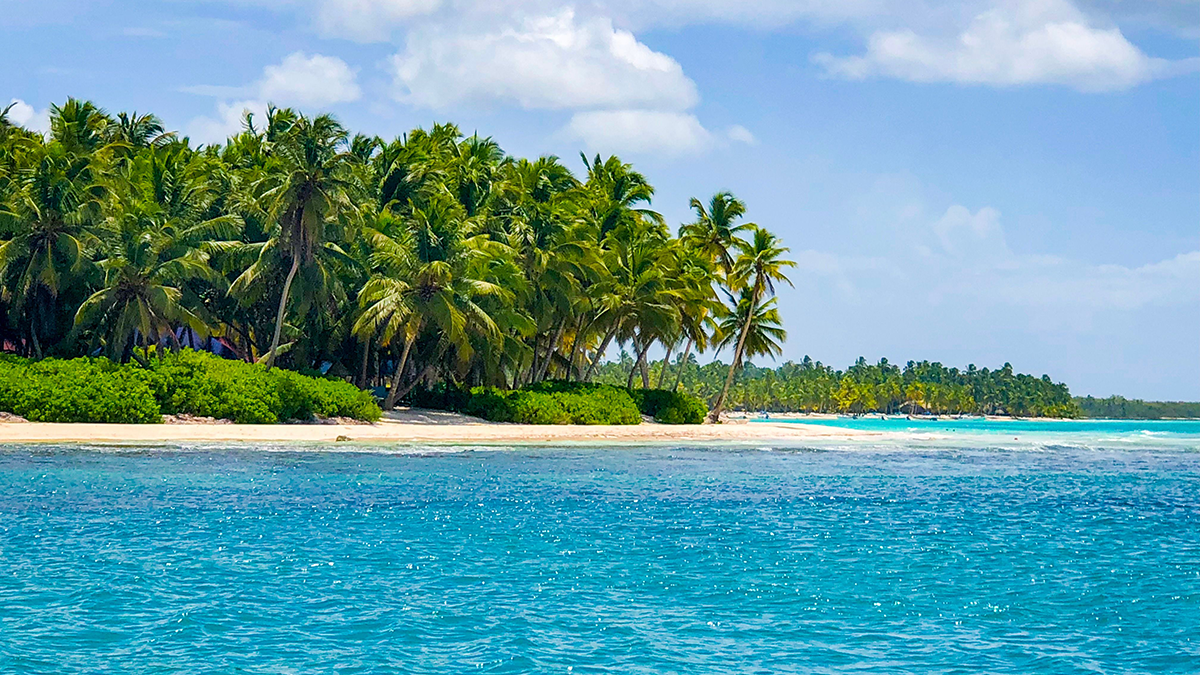
Featured photograph: Seabee314 / Wikimedia Commons, CC0 1.0. Resized. Illustrative image, not a photograph of the Canaries–Caribbean passage.
