Grand Soleil 60: Four Cabins and Room for the Sails
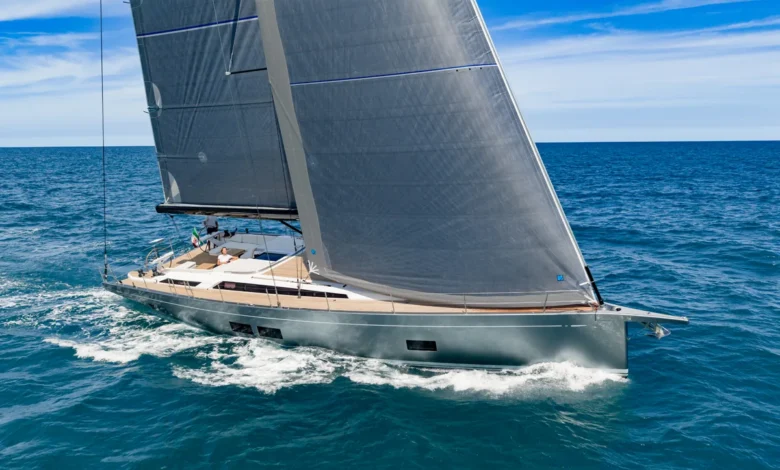
The first owner of the Grand Soleil 60 put two bunks where the pantry was meant to go. Right forward, where the yard can fit a crew berth, there’s a sail locker. That was the boat Cantiere del Pardo brought to Cannes in September 2026. See our 2024 preview of the project for the original design.
On the standard three-cabin boat, the pantry sits to starboard, opposite the U-shaped galley, and adds a worktop as well as storage. The first owner gave up both. The main galley stays where Nauta put it, one step down from the saloon. The worktop is just below the back of the sofa, so whoever is cooking can still talk to the people sitting there. At the other end of the sofa, you can sit down at the chart desk.

The owner’s double berth is offset to port in the forward cabin. Aft, both guest cabins have their own heads and showers. The port cabin has a double, while the starboard cabin comes with twins that can be replaced by a double.

The hull and rig
Matteo Polli’s hull carries its beam well aft. You see the benefit in the cockpit and in the two cabins underneath it. At the waterline, Polli describes a slimmer shape intended to keep drag down in light air. The boat draws 2.80 metres on a bulb keel and has a single spade rudder. That draught is also a figure you’ll want to keep in mind when looking at berths and anchorages.

Aluminium is standard for the mast, with carbon spars available as an upgrade. The yard also offers roller-furling and Park Avenue boom options. Up front, there are two electric furlers and two additional tack points on the bowsprit. If you intend to carry a Code sail and a gennaker, the locker in the bow starts to make particular sense.
What you can do from the wheel
On the standard boat, the mainsheet leads to a fixed point between the wheels. Other control lines run inside the cockpit coamings to the helm stations, where the clutches, electric Harken winches and hydraulic controls are within reach. The cockpit tables and guest seating are farther forward.

How much work the crew has to do depends on what’s set. With the self-tacking jib, there’s no sheet to pass across in a tack. The overlapping genoa adds a job, and setting the staysail brings the running backstays into play. You can reach more of the controls from the wheel, but the choice of headsail still makes a difference when there are only two of you aboard.
In a separate pre-Cannes sea trial off Ravenna, Alessandro Giuzio reported 5.6 knots of boat speed in 5.3 knots of true wind at a true wind angle of 95 degrees, with the 170-square-metre Performance gennaker set. The sail and the angle are worth keeping alongside the speed. They tell you more about that run than the yard’s broader claim of 6–7 knots in winds below 10. Yachting News sea trial, 9 September 2026
Grand Soleil 60 specifications
| Builder’s figures | |
|---|---|
| Length overall | 19.68 m |
| Hull length | 18.30 m |
| Maximum beam | 5.80 m |
| Draught | 2.80 m |
| Displacement | 27 t |
| Standard engine | 175 hp |
| Diesel capacity | 1,140 L |
| Freshwater capacity | 1,000 L |
| Performance gennaker | 170 m² |
Built by Cantiere del Pardo, with naval architecture by Matteo Polli and exterior design, interiors and general arrangement by Nauta Design.