Ouzel at Sea: The 95-Foot Modern Classic That Chose a Deep Keel
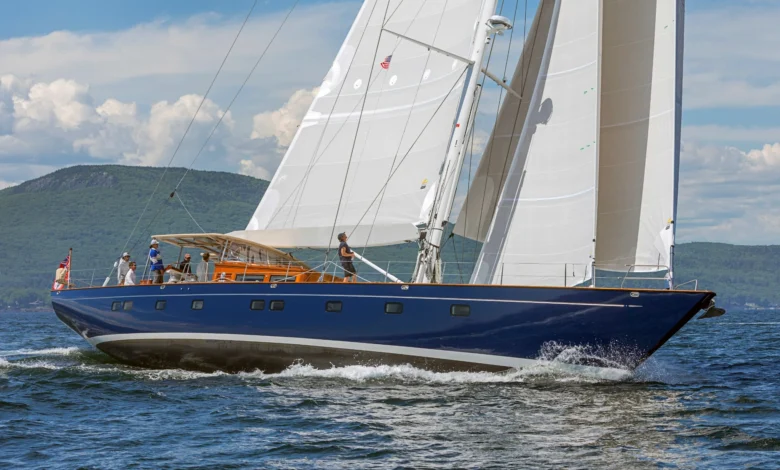
Built in Maine by Rockport Marine, Ouzel looks back to the classic sailing yachts of New England. Her underwater design, sail plan and first trials tell a rather different story.
Twelve feet of draft is not something you choose casually on a cruising yacht. It can mean giving up a sheltered anchorage, taking a longer route into harbor or simply accepting that some places will remain out of reach.
The owners of Ouzel knew the trade-off. They chose the deeper keel anyway.
That decision says quite a lot about this 95-foot sailing yacht, delivered by Rockport Marine in June 2026 after several years of construction in Maine. With her long overhangs, sweeping sheerline and traditional deckhouse, Ouzel could easily be mistaken for a design more concerned with appearances than sailing performance.
Look below the waterline and the picture changes.
Designed by Langan Design Partners of Newport, Rhode Island, Ouzel has a modern fin keel with a hydrodynamic bulb, a deep spade rudder and a draft of 3.66 metres. Her owners wanted the character of a classic yacht, but they had no intention of sacrificing the pleasure of sailing quickly and efficiently.
Their plans extended well beyond coastal cruising. Ouzel was conceived for passages ranging from tropical waters to higher latitudes, with the ability to cover long distances without demanding an unnecessarily complicated sail plan.

A classic yacht with different priorities
The project began in late 2021, when the owners approached Peter Wilson of MCM Newport about building a custom sailing yacht. They were experienced sailors, having previously owned a 64-foot Baltic, and had a particular wish: their next boat should be built in New England.
Langan Design Partners developed the naval architecture, Rockport Marine took responsibility for construction and Mark Whiteley Design joined the project from the UK to develop the interior and contribute to the exterior styling. MCM coordinated the build.
The result has the unmistakable profile of a traditional pilothouse yacht. The counter stern, teak-clad bulwarks and relatively low deckhouse are all part of that character.
There was, however, no attempt to reproduce a traditional underwater shape. Langan’s design uses a fin and bulb keel intended to deliver stability and efficient upwind performance. The owners accepted the limitations of the deeper draft because sailing performance mattered more to them than access to every shallow harbor.
There is a similar logic above deck.
Ouzel carries a carbon mast and Park Avenue boom supplied by Hall Spars, with a sail inventory developed by Doyle Sails. The principal combination includes a fully battened mainsail, a high-cut Yankee and a furling staysail. A blade jib offers another option for upwind sailing, while a Code Zero provides additional power when reaching. A trysail is also part of the inventory.
On a boat of this size, sail handling will never be effortless. The point is to make it manageable for a relatively small crew, with sail combinations that can be adapted to changing conditions rather than requiring frequent, demanding changes of large headsails.
For owners planning long passages, that is a practical consideration, not merely a matter of convenience.
What Ouzel showed under sail
Ouzel’s first sailing trials took place in Penobscot Bay in June 2026. According to the project team’s account, conditions were favorable, with relatively flat water and winds of around 10 to 15 knots.
Sailing upwind under Yankee and staysail, the yacht reached approximately 10 knots. When the sheets were eased onto a reach, speeds approached 12 knots. Rockport Marine also reported brief speeds above 13 knots as the breeze increased during the trials.
Those are interesting figures for a cruising yacht with a displacement of approximately 75 tonnes, particularly without relying on a complicated racing sail plan.
But the comments about handling are arguably more revealing.
Peter Wilson reported that the owner was especially pleased with the light feel of the helm, the visibility and the boat’s behavior upwind and on a reach. Tom Degrémont of Langan Design Partners, who sailed aboard during the trials, also highlighted the balance and sense of control.
A responsive helm is welcome on any sailing boat. On a 29-metre yacht intended to spend days or weeks offshore, predictable handling and good visibility have obvious value.
The distinction matters. A boat can produce impressive speeds during trials without necessarily being pleasant to manage over longer distances.
Ouzel’s initial results come from the yard and design team, rather than an independent SailUniverse sea trial. Penobscot Bay also provided relatively forgiving conditions. How the yacht behaves fully loaded, in rougher seas and over extended passages remains to be established.
Still, the early reports suggest that the emphasis on sailing performance was not misplaced.

Built in Maine, using wood in a modern way
There is another aspect of Ouzel worth examining, particularly given her owners’ decision to build in New England.
Rockport Marine constructed the hull using a cold-molded wood-composite technique. Douglas fir and western red cedar are laminated in layers running in different directions, with carbon fiber reinforcement, foam cores where required and an outer E-glass sheathing.
It is a method that requires considerable woodworking skill, although the resulting structure is very different from a traditional plank-on-frame wooden hull.
In an earlier SailUniverse interview, Sean McMillan, identified the availability of a highly skilled workforce as one of the principal challenges of building yachts in wood.
The use of carbon and engineered reinforcement allows the structure to accommodate the loads imposed by a modern keel and rig. At the same time, the laminated timber construction draws on techniques that have long been part of Maine’s boatbuilding culture.
Rockport Marine argues that wood-composite construction offers good structural performance and lower maintenance requirements than traditional wooden construction. That does not make the hull maintenance-free. As with any laminated structure, the integrity of protective coatings and the prevention of moisture intrusion remain important over the boat’s working life.

What is interesting about Ouzel is that wood was not chosen simply to make the yacht look traditional. It is part of the engineering solution.
The interior follows a similarly restrained approach. Mark Whiteley Design has used mahogany cabinetry, painted panels and classical proportions, but the general arrangement also reflects the requirements of an offshore yacht.
The raised saloon includes a substantial navigation station to starboard, while a separate lower saloon accommodates the main dining and seating areas. There are three guest cabins and one crew cabin.
For a boat intended to spend considerable time away from marinas, the relationship between living space, navigation and practical operation is more relevant than decorative detail alone.

From a construction project to a sailing yacht
When Sail Universe first reported on Project Ouzel in August 2023, the boat was still taking shape at Rockport Marine. At that point, the interesting question was whether the design team could deliver the combination of classic appearance and modern performance the owners were seeking.
Ouzel was technically launched in November 2025, completed her first sailing trials the following June and was delivered later that month.
The builders now have some evidence that their decisions worked, at least in the conditions encountered during those initial outings.
The yacht still has plenty to prove on longer passages. A few days sailing in Penobscot Bay cannot tell us everything about her behavior offshore, or how easily her systems will be maintained far from a yard.
But one thing is already clear from the design.
Ouzel’s owners were prepared to compromise on shallow-water access to get the sailing characteristics they wanted. They could have specified a shallower keel. They didn’t.
That is perhaps the most useful detail to remember when looking at this thoroughly modern yacht dressed in classic lines.