Route du Rhum 2026: Start Date, Classes and Skippers to Watch
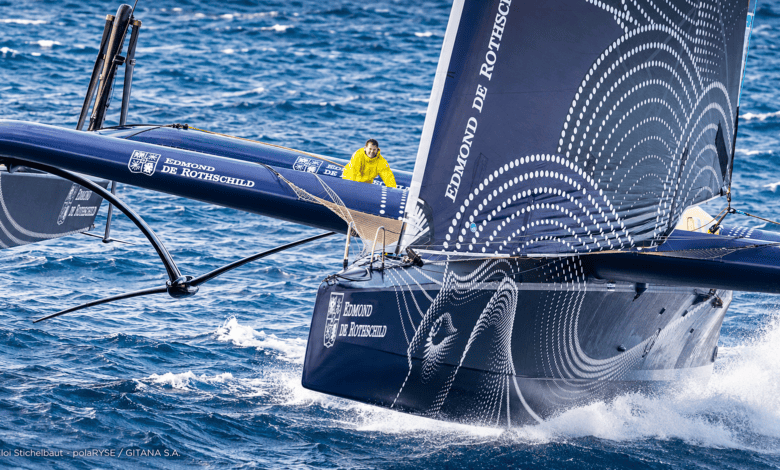
The 2026 Route du Rhum – Destination Guadeloupe got underway on Sunday, November 1, with 115 solo sailors leaving Saint-Malo for Pointe-à-Pitre. The 13th edition covers a reference distance of 3,542 nautical miles, bringing together six classes ranging from 32-metre Ultim trimarans to Class40 monohulls and older ocean-racing yachts.
The fleet began in relatively gentle conditions, with northeast winds of 8–11 knots. But the opening weather pattern presented an unusual challenge: instead of heading directly towards the Caribbean, the skippers were expected to sail northwest towards the Celtic Sea before turning back towards the Atlantic.
It is an interesting starting point for a race that brings together boats with very different capabilities. Each class has its own competition, and the weather decisions that work for a foiling Ultim may be quite different from those facing a Class40 or a Vintage yacht.
This guide covers the Route du Rhum 2026 course, competing classes, leading skippers and the factors that could decide the race. For the latest developments, dated position reports and weather analysis, follow our Route du Rhum 2026 race updates.
When did the Route du Rhum 2026 start?
The Route du Rhum 2026 started on Sunday, November 1, at 13:02 CET, off Saint-Malo on the northern coast of Brittany. All 115 competitors crossed the start line, beginning the singlehanded transatlantic race to Pointe-à-Pitre, Guadeloupe.
The race is held every four years and has followed the same basic course since its first edition in 1978. Competitors sail singlehanded across the Atlantic to Pointe-à-Pitre, on the Caribbean island of Guadeloupe.
According to the official Route du Rhum course information, the reference distance is 3,542 nautical miles. Actual distances sailed will be longer and will depend on the weather, the performance of each boat and the decisions made by its skipper.
The fleet is currently divided into six classes and categories:
- Ultim: Eight large offshore racing trimarans.
- Ocean Fifty: Ten 50-foot racing trimarans.
- IMOCA: Twenty-two 60-foot offshore racing monohulls.
- Class40: Forty-nine 40-foot monohulls, the largest fleet in the race.
- Vintage Multi: Thirteen multihulls representing different generations of ocean racing.
- Vintage Mono: Thirteen monohulls, including boats associated with earlier periods of offshore competition.
Each category has its own classification. A skipper racing a Class40 is not competing directly for a class victory against an Ultim, although every boat shares the same ocean passage.
The Atlantic crossing: where the race can be won or lost
The Route du Rhum is often described as a transatlantic sprint. For the faster multihulls, the race can be completed in less than a week. For smaller or slower boats, it can demand considerably more time at sea.
But distance alone does not explain the difficulty.
The opening challenge in 2026 was rather different from the difficult November departures that Saint-Malo can sometimes produce. The fleet started in light to moderate northeast winds, with Cap Fréhel serving as the first compulsory mark, 16 nautical miles from the starting line.
From there, the weather pattern initially favoured a northwestward course towards the Celtic Sea. According to the organiser’s forecast on November 1, skippers would have to judge how long to remain north before gybing towards the Atlantic. Staying in stronger winds could mean sailing additional miles, while taking a more direct route risked reaching lighter conditions sooner.
The next obstacle was expected to be a narrow passage between two high-pressure systems. Timing the approach could prove important, particularly for the faster boats arriving ahead of the rest of the fleet.
Beyond these opening decisions, the broader North Atlantic pressure systems remain central to the race. The position of the Azores High can create areas of light wind that separate boats taking different routes.
Farther south, the trade winds offer opportunities for sustained downwind sailing towards the Caribbean. Reaching them efficiently, however, is not always as straightforward as heading south as quickly as possible.
For the skippers, the essential question is how to find the fastest practical route while managing the risks associated with their boat, its equipment and the forecast conditions.
The consequences are particularly important in a race where there is no crew to share sail changes, navigation, repairs or rest periods.
Ultim: the battle between eight offshore trimarans
The Ultim class attracts considerable attention because of its combination of size, speed and increasingly sophisticated foiling technology.

These trimarans, measuring approximately 32 metres in length, are capable of maintaining high average speeds offshore. Yet keeping such a large and powerful boat sailing efficiently without a crew requires constant attention to the weather, sail configuration and onboard systems.
Charles Caudrelier returns as the defending winner, this time aboard the new Gitana 18, the latest Maxi Edmond de Rothschild.
His 2022 victory established the Route du Rhum race record at 6 days, 19 hours, 47 minutes and 25 seconds. Defending that result with a newly developed boat presents a different challenge, particularly when reliability and the ability to exploit the available performance have not yet been fully tested in direct solo competition.
Among his competitors are Armel Le Cléac’h, aboard Maxi Banque Populaire XI, Tom Laperche on SVR-Lazartigue and Thomas Coville on Sodebo Ultim 3.
Anthony Marchand, Louis Burton, Alexia Barrier and Guirec Soudée complete a fleet that combines established campaigns with different levels of experience on their current boats.
The Ultim contest will be about more than outright speed. A conservative sail choice or a more cautious passage through difficult conditions can sometimes prove more effective than pushing a boat close to its performance limits.
IMOCA: established contenders and a new generation
The IMOCA class brings together 60-foot monohulls developed for demanding offshore races, including the Vendée Globe.
Foiling designs have changed how these boats perform, particularly at higher speeds and on certain points of sail. They have also introduced additional demands on skippers, from managing loads to maintaining control and reliability over long passages.
Sam Goodchild, aboard MACIF Santé Prévoyance, is among the leading contenders after a strong period of competitive results.
He will face Jérémie Beyou on Charal, as well as skippers including Sébastien Simon, Boris Herrmann, Violette Dorange and Francesca Clapcich.
Another name to follow is Ambrogio Beccaria, now competing in IMOCA with Allagrande Mapei.

Beccaria finished second in the Class40 division of the 2022 Route du Rhum and subsequently strengthened his offshore record with victory in The Transat CIC. Sail Universe previously covered Ambrogio Beccaria’s Class40 victory in The Transat CIC.
His move into IMOCA adds another dimension to a competitive fleet. The challenge is not simply adapting to a larger boat, but learning to manage its performance across changing Atlantic conditions while sailing alone.
The relatively gentle, downwind start on November 1 gave the IMOCA fleet an opportunity to settle into the race before the expected stronger conditions offshore. As the weather develops, differences in boat design, sail choices and the ability to maintain speed through transitions could become increasingly important.
Class40: a closely contested fleet
With 49 boats, Class40 is the largest category in the Route du Rhum 2026.
The class has developed into an established part of professional offshore racing, while retaining opportunities for experienced amateur sailors to compete.
Although the boats share a common box rule, their designs and ages vary. Recent hull developments, particularly the use of wider scow-type bows, have influenced performance and the competitive balance within the fleet.
Among the principal contenders are Corentin Douguet, aboard SNSM, Faites un don!, and Guillaume Pirouelle, on Sogestran–Seafrigo. Both came into the race with established competitive credentials, although the depth of the 49-boat fleet leaves plenty of room for other skippers to challenge them.
Other contenders include Ian Lipinski, Alexis Loison, Fabien Delahaye, Axel Tréhin and Achille Nebout. Italian skipper Luca Rosetti will also be among the sailors aiming to make an impression.
In Class40, the outcome may depend as much on consistency as on peak performance.
Over a long solo passage, maintaining an effective average speed without exhausting the skipper or overstressing the boat can be more valuable than a brief period of faster sailing.
Ocean Fifty and the Vintage classes: different boats, different challenges
The Ocean Fifty class features ten racing trimarans measuring approximately 15 metres.
These are powerful multihulls that can deliver demanding handling conditions for a solo skipper. Their performance depends on balancing sail power, trim and the ability to respond quickly to changing weather.
Among those to watch are Thibaut Vauchel-Camus, Basile Bourgnon and Luke Berry.
The class also has a history of close finishes. In 2022, Erwan Le Roux won the division after a race in which the leading two boats finished only around 18 minutes apart.
The Vintage Multi and Vintage Mono categories introduce a different element to the event.
Rather than representing a single modern racing design, these fleets bring together boats from earlier generations of offshore competition.
Skippers such as Francis Joyon in Vintage Multi and Jean Le Cam in Vintage Mono connect the 2026 edition with the history of ocean racing.
Their participation is also a reminder that advances in boat design do not replace seamanship, preparation and experience.
The ability to keep an older boat operating reliably throughout an ocean passage can be just as important as extracting additional speed from a newer design.
What will decide the Route du Rhum 2026?
While each class has its own technical characteristics, several factors will influence the outcome across the fleet.
Weather strategy will be central. Skippers must choose between different routes around pressure systems, weighing potential gains against additional distance or exposure to stronger conditions.
Reliability will be equally important. Foils, rudders, sails, autopilots and electrical systems all need to continue working throughout the crossing. A technical problem can cost hours or force a retirement.
Fatigue management remains one of the defining aspects of solo racing. The skipper is responsible for navigation, sail changes, equipment checks and rest, often while dealing with demanding sea conditions.
The demands of singlehanded sailing are not limited to racing. They are explored from a different perspective in our article on the advantages and challenges of sailing alone versus sailing with a crew.
Finally, there is the question of boat development. Several skippers are bringing relatively new designs into the race, while others have spent longer refining established platforms.
The fastest boat on paper may not necessarily be the one that completes the passage most effectively.
A race shaped by nearly five decades of ocean sailing
The first Route du Rhum took place in 1978, when Mike Birch won aboard the trimaran Olympus Photo.
Since then, the event has followed the development of offshore sailing through successive generations of monohulls and multihulls.
In 2006, Lionel Lemonchois won the Route du Rhum aboard Gitana 11, an ORMA trimaran that completed the Atlantic crossing in just over seven days.

Its winners include Florence Arthaud, Francis Joyon, Loïck Peyron and Marc Pajot, who won the race in 1982 and later developed a career in yacht design. Sail Universe has also covered Marc Pajot’s work on sailing catamaran design.
The race has also become an important meeting point for sailors with different backgrounds, from experienced professionals to competitors managing relatively modest campaigns.
That variety remains part of its identity in 2026.
How to follow the Route du Rhum 2026
The Route du Rhum’s official website provides race reports, skipper profiles and the position tracker, where readers can follow the progress of each class across the Atlantic.
The 2026 race began on November 1, and its opening stages have already highlighted the different tactical and technical demands facing the fleet. From the foiling Ultim trimarans to the Class40 and Vintage entries, the boats may be sailing towards the same destination, but their races will develop at very different speeds.
Sail Universe is following the event through its Route du Rhum 2026 race updates, with dated reports on weather, strategy, incidents and the developments that matter on the water.